
Introduction: The Global Shift in Poultry Power
In 2026, Brazil marks over 50 years as a global poultry export powerhouse, a milestone few agricultural sectors can rival. What began as a regional export strategy has evolved into a position of strategic dominance, reshaping global protein trade flows. While U.S. poultry remains influential, Brazilian frozen chicken continues to outperform it across key international markets.
The reason is not a single advantage, but a resilient, multi-layered system—from biosecurity and feed economics to currency dynamics and product customization. Together, these factors explain why Brazil now controls approximately 38% of global poultry exports, compared to the U.S. at 27%, and why that gap is widening rather than closing.
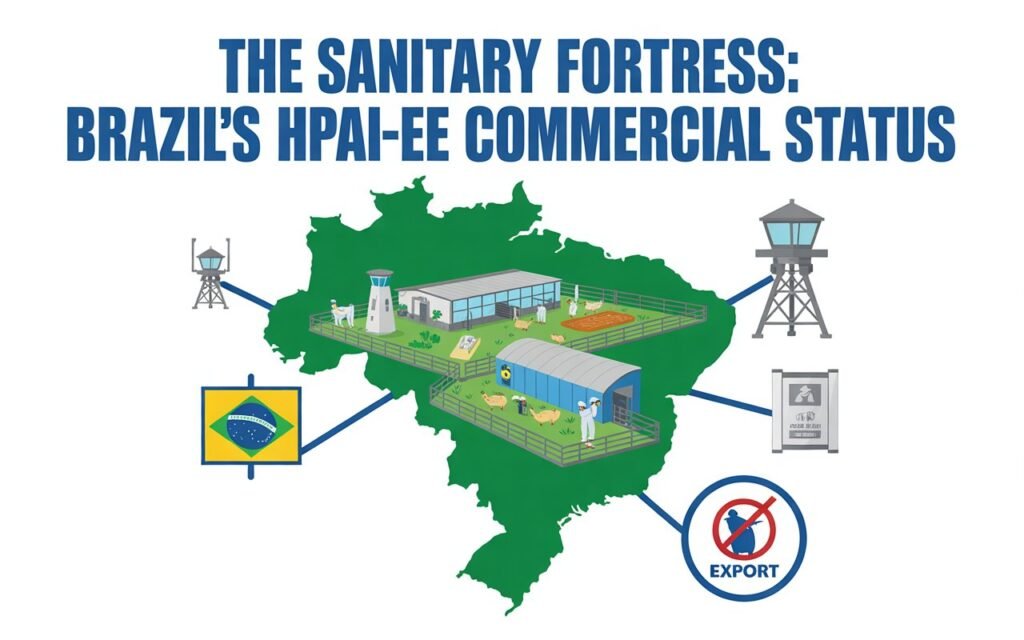
The Sanitary Fortress: Brazil’s HPAI-Free Commercial Status
One of Brazil’s most powerful competitive advantages is its HPAI-free commercial poultry status. Unlike the United States, which continues to battle recurring outbreaks of Avian Influenza, Brazil has maintained a sanitary fortress built on strict biosecurity protocols enforced by MAPA (Ministry of Agriculture and Livestock).
A defining moment came in 2026 with the successful containment of the Montenegro case, where rapid compartmentalization, farm isolation, and traceability measures prevented any disruption to exports. This reinforced international confidence in Brazil’s sanitary protocols, allowing uninterrupted access to premium markets.
For importers, stability matters more than volume. Brazil delivers both.
Feed Cost Advantage: The Soybean and Corn Synergy
Brazil’s poultry industry benefits from direct proximity to the world’s largest maize production and soybean meal supply chains. This geographical advantage creates powerful agro-industrial clusters, where grain production, feed mills, hatcheries, and processing plants operate within a tightly integrated radius.
The result is:
-
Lower transportation costs
-
Improved feed conversion ratios (FCR)
-
Predictable input pricing
In contrast, U.S. producers often face higher volatility in feed costs due to logistics and regional imbalances. Brazil’s vertical integration transforms feed efficiency into a structural price advantage.
Halal Market Dominance: Precision in Religious Compliance
Brazil is the undisputed leader in Halal poultry exports, particularly to the Middle East and North Africa. While U.S. poultry often relies on dark meat surplus for these markets, Brazil engineers production specifically for religious and regulatory compliance.
Brazilian plants operating under the SIF (Federal Inspection Service) work closely with Halal authorities to meet GSO standards and the requirements of the Saudi Food and Drug Authority (SFDA). This precision—covering slaughter methods, auditor presence, and documentation—builds trust that U.S. suppliers struggle to match consistently.
For Halal buyers, Brazil is not an alternative supplier—it is the benchmark.
Currency Dynamics: How a Competitive Real (BRL) Lowers Global Prices
In 2026, USD/BRL exchange rate dynamics continue to favor Brazilian exporters. A relatively weaker Brazilian Real allows exporters to offer highly competitive FOB pricing without compressing margins.
This currency advantage translates into:
-
Lower price per metric ton for buyers
-
Stronger Brazilian trade balance
-
Greater resilience to global exchange rate volatility
While U.S. poultry exports are priced in a strong dollar, Brazilian suppliers leverage currency dynamics as a silent but decisive weapon in global price negotiations.
Tailored Product Engineering: Meeting Asian Consumer Demands
Brazil does not treat exports as surplus—it treats them as engineered products. Nowhere is this clearer than in Asia, where demand for Grade A chicken paws, mid-joint wings (MJW), and precision-cut items continues to grow.
Brazilian processors invest heavily in:
-
Advanced deboning technology
-
Specialized cutting lines
-
Market-specific grading standards
The U.S. export model often offloads secondary cuts, whereas Brazil designs production around end-market preferences, capturing higher value and stronger loyalty.
The Green Export: Sustainability and Decarbonization in 2026
Sustainability has shifted from marketing language to trade requirement. Brazil’s poultry sector benefits from a naturally low carbon footprint, driven by:
-
Naturally ventilated poultry houses
-
Renewable feed inputs
-
Efficient land-use models
Exporters increasingly provide traceable supply chain data, aligning with ESG expectations on animal welfare, emissions reporting, and environmental compliance. For climate-conscious buyers, Brazilian frozen chicken offers both affordability and sustainability credibility.
Regionalization: The Diplomatic Strategy Saving Exports
Brazil’s diplomatic mastery of regionalization and compartmentalization is another decisive advantage. Instead of accepting country-level bans during sanitary incidents, Brazil negotiates state-level or zone-specific restrictions.
Through proactive trade agreements, health certificates, and transparency with importing authorities, Brazil protects the continuity of exports—even during isolated health events. The U.S., by contrast, often faces broader bans that disrupt supply chains overnight.
Logistics and Cold Chain Infrastructure Excellence
Brazil’s export success is supported by world-class logistics. Ports such as Paranaguá and Itajaí are optimized for poultry exports, offering:
-
High-capacity reefer containers
-
Efficient cold storage integration
-
Short port turnaround times
These advantages ensure product integrity across long shipping lanes to Asia, the Middle East, and Africa—reducing risk, shrinkage, and delays.
Advanced Genetics and Artificial Intelligence on the Farm
Brazilian poultry farms are increasingly driven by AI-powered smart-farm monitoring. Machine learning systems track bird health, environmental conditions, and feed performance in real time.
Coupled with advanced genomic selection, these technologies improve:
-
Hatchability rates
-
Disease resistance
-
Uniformity and yield
The result is consistent quality at scale—an essential requirement for demanding global buyers.
Conclusion: Why Brazil Remains the “World’s Butcher” for 2026
As global poultry trade moves into 2026, Brazil’s leadership position looks increasingly secure. With a 38% global export market share versus the U.S. at 27%, the gap reflects more than volume—it reflects strategy.
Brazil’s success is built on:
-
Sanitary stability
-
Cost-efficient feed systems
-
Halal dominance
-
Currency competitiveness
-
Product specialization
-
Sustainability leadership
In an era defined by uncertainty, Brazil offers what global markets value most: stability, reliability, and scalable growth. That is why Brazilian frozen chicken is not just competing—it is winning.